Posts

Showing posts with the label MeSH

Tip #55: How and why to search previous indexing of MeSH terms in PubMed, plus the alphabet soup of PubMed's date fields

Image
You probably know that Medical Subject Headings (MeSH) evolve over time; you can read more about why and how in the Introduction to MeSH , under Changes to MeSH Terminology. You may also have noticed that, in the MeSH Database , some MeSH headings have no dates, some have one, and some have two. "What do the dates mean in MeSH?" is a hot topic (and is explained in this brief YouTube video , if you'd like the basics in less than two minutes).  To sum up: If no date is listed, it means the term has been used since MEDLINE began in 1963.  If there's a single date, it's the year the term was introduced, and no other term has ever been used for that concept. If two dates are listed next to Year introduced, which looks like YYYY (earlier yyyy) : The first date, YYYY , is when that MeSH heading was added, but not when the concept  was first added to MEDLINE. The date in parentheses ( earlier yyyy ) is when the concept  was introduced, but at the time was called somethin...

Tip #51: MeSH Major Topics across PubMed and Ovid, with a bonus glimpse of changes to NLM indexing practices

Image
You might think that a recent publication indexed in PubMed with Epilepsy, Temporal Lobe* / pathology  would be retrieved by this query in Ovid MEDLINE :   *Epilepsy, Temporal Lobe / pa [Pathology]   You would be incorrect. One example is Xie K, Royer J, Larivière S, et al. Atypical connectome topography and signal flow in temporal lobe epilepsy. Prog Neurobiol. 2024;236:102604 . doi:10.1016/j.pneurobio.2024.102604.  and you can compare for yourself by searching for 38604584.ui in your preferred Ovid Medline segment, where it will show   This issue, of Major Topic MeSH-with-subheading not being accurately imported into Ovid, seems to affect literally every article since mid-2022 with a Heading/subheading combination marked as a Major Topic. What’s happening, and why? At the moment of intake processing, Ovid breaks apart headings consisting of a Major Topic and subheading.   NLM Data Ovid HIV Infections* ...

Tip #33: Catalog-only MeSH Terms

Image
I was recently digging through some MeSH terms while trying to find a paper about statistics and prevalence in PubMed. I found the following MeSH term: "Statistics" [Publication Type] ...but when I tried to include it in my search string, my results were flagged with a "Quoted phrase not found in phrase index: Statistics" error message: Ryan Cohen, MLIS, Customer Service Librarian, Contractor for the National Library of Medicine, NIH responded to my confused Tweet with some very helpful information about this type of MeSH term. Thanks, Ryan! MeSH terms/publication types are used for both cataloging records in the NLM Catalog/LocatorPlus and for indexing the citations of articles in MEDLINE. There are some MeSH terms/publication types that are only used for cataloging and/or indexing. The statistics MeSH publication type term is only used for cataloging records in the NLM Catalog/LocatorPlus . See the annotation on the MeSH browser record: Statistics MeSH ...

Tip #21: Term Finder in Ovid MEDLINE

Image
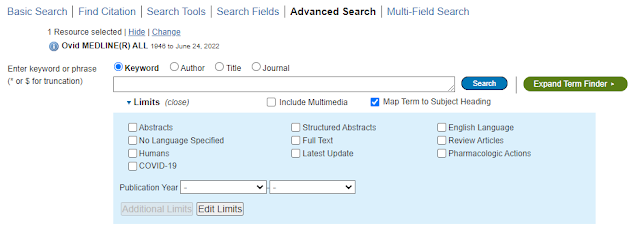
If you're like me and learned to use Ovid many years ago, you will sometimes miss new features on the platform. I learned about one of these features last week while participating in user testing for Ovid. The feature, Term Finder , is not new at all at this point - it was released in fall 2020!  Term Finder is an alternative way to look up MeSH in Ovid MEDLINE. It's located to the right of the search bar. It returns any mapped terms along with the various features -- the tree, entry terms, the scope note, available subheadings, etc. -- that we're used to navigating in the old step-by-step term mapping: I haven't had the opportunity to use the Term Finder for a search yet. As a single-line searcher who prefers to construct his searches in a text document rather than "on the fly" in the platform, however, it may end up making the process of gathering MeSH terms a bit more efficient. If you've used the Term Finder, let us know in the comments if you've f...